
How High Should A Bed Be: Find Your Ideal Height Now

Your bed height directly affects how well you sleep and how easily you move through your day. I’ve spent years helping people find that sweet spot, usually 16 to 30 inches total, where your knees align with your hips when you sit at the edge. Too low, and you strain to stand; too high, and your feet dangle like a kid at the grown‑up table.
But here’s what most people miss: your mattress thickness and frame type completely change the math. Let me walk you through how to nail this.
How high should a bed be

The ideal bed height generally falls between 16 and 25 inches from floor to mattress top, though I’ll tell you right now, your perfect number depends on your body and how you actually use your bed.
Why Your Body Matters Most
I’m a big believer in the knee‑hip alignment test. Sit on your bed’s edge with feet flat on the floor. Your knees should hit roughly 90 degrees, thighs parallel to the floor. If your legs dangle like a kid at a grown‑up table, your bed’s too high. If your knees jut upward, it’s too low. Simple as that.
Taller folks? You’ll probably love 22–25 inches for easier standing. Platform beds typically sit around 18 inches, while standard beds with a foundation/box spring reach about 25. Remember: mattress height plus frame equals your total, so plan accordingly.
Why does bed height matter for comfort

Getting in and out of bed should feel effortless, not like a morning workout or a risky stumble. That’s why bed height directly impacts your daily comfort and long-term wellbeing.
When your knees rest at roughly 90 degrees with feet flat on the floor, you’ve found your sweet spot. This position minimizes strain on hips and knees during transitions.
- Too low: Squatting strains joints and challenges mobility
- Too high: Legs dangle uncomfortably, increasing fall risk
Many shoppers overlook how mattress thickness stacks with your foundation. A plush 14‑inch mattress atop a standard frame can push your sleep surface well above 25 inches, potentially too tall for shorter sleepers.
For anyone managing arthritis, recovering from surgery, or simply aging gracefully, proper bed height transforms bedtime from a chore back into a comfort.
How to measure bed height accurately

I measure my bed height by starting at the floor and working my way up, checking each layer that lifts me toward the ceiling. First, I note the distance from floor to slats or foundation, then add the box spring if I’ve got one, and finally stack on my mattress thickness to get my true sleeping surface. That total number tells me whether I’m climbing into a low platform or scaling a tall antique frame.
floor to slats
Here’s how I do it myself. I place a straight edge on the floor beneath the slats and measure straight up to the top surface, no mattress included. That’s your true bed height.
Why the floor-to-slats method matters
Most slats-based bed height falls between 16–24 inches. Add your mattress thickness to that number for your total sleep surface. I always double-check with a level to ensure slats sit parallel to the floor, uneven slats throw everything off.
| Bed Component | Typical Range | Why It Counts |
|---|---|---|
| Floor to slats | 16–24 in | Base height for calculations |
| Mattress thickness | 8–14 in | Adds to total elevation |
| Total sleep height | 24–38 in | Ease of getting in/out |
| Personal preference | Varies | Mobility and style needs |
Getting this right means no surprise tiptoeing or climbing into bed.
foundation height
grab a tape measure. Check frame specs, add your mattress thickness, then test the sit test, hips level with or above your knees, feet flat.
Too low? Try risers. Too high? Swap that bulky box spring for a slatted base.
mattress height
How exactly do you pin down your bed’s true height? You measure from the floor straight up to where your cheek actually lands, the top of your mattress.
Here’s the breakdown that’ll save you from a climb or a squat:
| Component | Typical Range | What It Adds |
|---|---|---|
| Platform frame | 5–12 inches | Low, modern profile |
| Traditional frame | 16–24 inches | Classic, easier stand-up |
| Mattress thickness | 8–14 inches | Your main comfort layer |
| Total bed height | 25–30 inches | Ideal for most adults |
I always tell folks: mattress thickness drives everything. Pick a 14-inch plush model, and you’re adding serious elevation. Match that with your frame height, and you’ll know exactly how high you’re sleeping before you buy.
total height
- Measure mattress thickness separately (usually 10–14 inches)
- Add bed frame height or foundation height to that number
- Include box springs if you’ve got ’em, about 7 inches right there
- Sit-test: feet flat, knees at 90 degrees when you hit the mattress edge
- Compare against benchmarks: platform beds ~18″, standard setups ~25″, tall storage beds up to 36″
Your ideal bed height depends on your body and mobility. I’m 5’6″ and prefer around 22 inches, easy in, easy out, no morning struggle.
Choosing the right bed height for you

I’ll help you find your perfect bed height by considering your height, age, mobility, and even your partner’s needs, since what works for one sleeper might leave another struggling to climb in or out comfortably. Let’s break down how each factor shapes your ideal setup so you can wake up refreshed instead of sore.
your height
Why does your height matter so much when picking a bed? Your body proportions directly affect how easily you get in and out, and whether you land in that optimal seated position with your feet flat and knees at 90 degrees.
I’m going to break down how height by height changes what works best for you:
- Taller folks (5’10″+): I recommend aiming for 22–25 inches total bed height so you’re not crouching down
- Average height: You’ve got flexibility, but 20–23 inches usually hits the sweet spot
- Shorter sleepers: 16–18 inches prevents your legs from dangling uncomfortably
- Check your seated position: Sit on the edge, if your feet don’t reach flat, adjust
- Calculate total bed height: Add mattress + foundation + frame together
Your height isn’t just about comfort—it’s about effortless movement every single morning and night.
age and mobility
How do your age and daily movements reshape what “the perfect bed height” actually means for you? Let me break it down.
Seniors and Limited Mobility
I always tell older adults: your bed height should place your hips level with or slightly above your knees when sitting. This sweet spot, usually 20–23 inches, prevents that scary struggle to stand up. I’ve seen how the wrong height turns bedtime into an obstacle course.
| Age Group | Recommended Bed Height | Why It Works |
|---|---|---|
| Children (2–6) | Lower (under 18″) | Safer for small bodies |
| Adults | 16–24″ | Matches leg length |
| Seniors | 20–23″ | Easier sit-to-stand |
Planning Ahead
If your mobility changes, adjustable bases are lifesavers. They let you raise or lower your sleep surface as needs evolve, no new bed required.
Remember: measure total height including your mattress and any toppers. That “perfect” number on the frame means nothing if your plush topper adds three inches.
partner needs
Finding the right bed height gets trickier when you’re sharing your sleep space with someone else. I’ve helped countless couples navigate this challenge, and I’ve learned that partner needs require thoughtful compromise. When my clients have significant height differences, I recommend evaluating these factors together:
- Measure both partners’ sitting heights from floor to knee crease
- Test how each person feels getting in and out at various heights
- Consider who struggles more with mobility or joint stiffness
- Factor in your combined mattress and foundation thickness
- Explore whether an adjustable bed frame could solve your mismatch
A middle‑ground bed height usually works, but don’t sacrifice entry/exit comfort for either partner. I’ve seen relationships transform when both people can start and end their day without strain. An adjustable bed frame offers the ultimate flexibility—each side rises independently so you both win.
mattress support
Your mattress and frame work together as a team to set your bed’s final height, so I always start by measuring the full stack before buying anything. I’ve learned that mattress thickness alone can add 8–14 inches, and if you’re using a foundation or box spring, that pushes bed height even higher.
Platform beds sit lower, usually 5–12 inches, and often skip the foundation entirely. That streamlined look feels modern and keeps you closer to the floor.
Traditional frames with box springs? They typically land you at 16–24 inches total, which many folks find easier for sitting down and standing up.
My Quick Test
Before committing, I sit at the edge: feet flat, knees at roughly 90 degrees. If that feels natural, I’ve found my sweet spot.
room size
- Small rooms: I lean toward a low-profile bed (under 18 inches) to maximize floor area and create breathing room
- Standard spaces: A 25-inch mid-height balances presence without crowding
- High ceilings: Taller beds (25–36 inches) complement vertical space beautifully
- Cramped quarters: I always preserve equal clearance on both sides for accessibility
- Visual space: Lower beds recede; higher beds command attention, choose based on what you want to emphasize
Your bed height literally shapes how spacious your sanctuary feels. I’ve seen tiny bedrooms transform simply by swapping a towering frame for something closer to the ground.
comfort preference
I always test this: sit on the edge with feet flat and knees at hip level, 90-degree bend tells you if you’ll get in and out with mobility ease. Taller folks like me often need 22–25 inches, while shorter sleepers prefer 16–18 inches.
Your mattress thickness changes everything. Add a plush topper or thick foundation, and suddenly that “perfect” frame feels too high. I measure the total stack before buying.
Adjustable bases let me tweak height as my joints or needs change, worth considering if you’re investing long-term.
Bed frame types and typical heights

- Platform beds: Sleek and low at 5–18 inches, often skipping the box spring entirely
- Traditional frames with box springs: The standard bed height lands around 16–24 inches, easy on the knees
- Sleigh beds & high-profile frames: These elegant options reach 25–30 inches, making a statement
- Adjustable bases: Total bed height becomes customizable for your exact needs
- Loft beds: Towering at 60–72 inches, they transform floor space completely
I always tell clients: match your frame to your mobility, style, and storage needs.
The right height isn’t just about looks, it’s about effortless mornings and cozy nights.
Should I choose a high or low bed

Why does bed height matter so much for your daily comfort? It determines how easily you’ll rise each morning and how spacious your bedroom feels.
Finding Your Perfect Bed Height
I’ve learned that choosing between high beds and low beds depends on your space and lifestyle. High beds (25–36 inches) suit rooms with soaring ceilings and give you generous under‑bed storage, perfect for stashing seasonal items. However, they can overwhelm compact spaces.
Low beds deliver that coveted minimalist aesthetic. Platform beds sit just 5–12 inches off the floor, often eliminating box springs entirely. They’re ideal for tight quarters but sacrifice storage space.
My Advice
Test your knee-to-hip alignment: sit at the edge with feet flat on the floor. If your knees hit your chest, it’s too low; if your legs dangle, it’s too high. Your ideal bed height balances comfort, function, and room proportions beautifully.
Common bed height mistakes to avoid
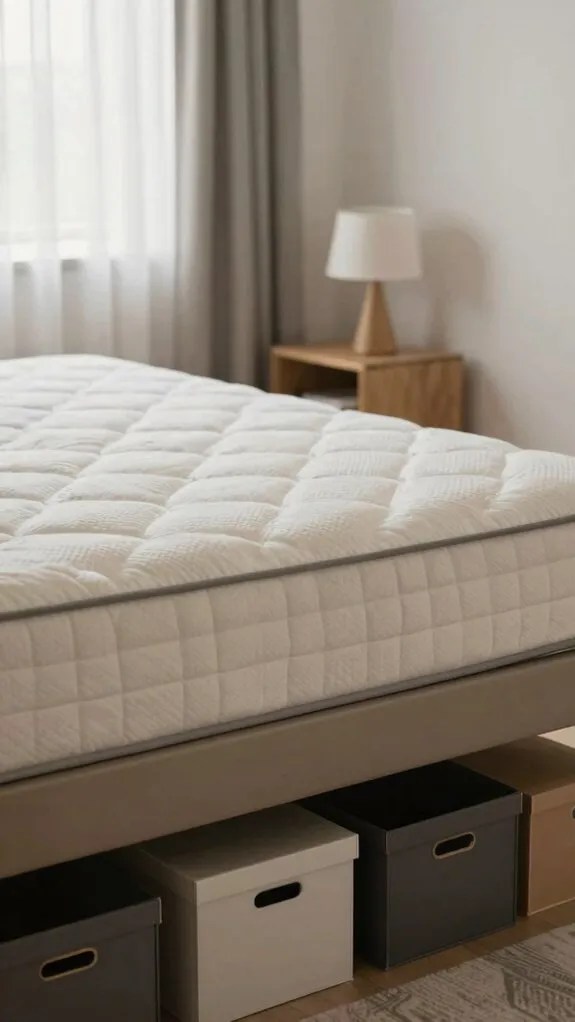
What’s the one detail that can turn a dreamy bedroom into a daily struggle? Bed height. I’ve seen too many people miss the mark, and it costs them comfort and safety every single day.
Common Mistakes I Help People Avoid
- Ignoring mattress foundations—your frame height means nothing until you calculate the total stack
- Skipping the sit test: feet flat, knees at 90 degrees, hips aligned
- Choosing looks over mobility considerations, gorgeous doesn’t help if you can’t stand safely
- Forgetting that ease of getting in and out changes as we age or recover from injury
- Measuring without your actual mattress—I’ve watched knees buckle from surprise height
Test before you buy. Your future self will thank you.
Frequently Asked Questions
Why Are Beds so Low to the Ground Now?
I notice beds sit lower now because modern design favors minimalist, sleek aesthetics.
Platform styles under 18 inches eliminate box springs, save money, and maximize floor space in compact rooms, though I’ll admit they’re tougher for some folks to climb out of.
What Is the Best Bed Height for Seniors?
Picture this: your feet flat on the floor, knees at a comfortable angle, pure bliss, right? I recommend 20–23 inches for seniors; it eases standing, reduces joint strain, and keeps you steady when getting in or out.
What Is the Trending Bed Height?
I notice trending bed heights cluster around 25 inches, though I’m seeing strong interest in lower 16–18 inch platform styles and adjustable bases that let me customize height overnight. Hybrid setups near 22–25 inches are also gaining popularity.
Can Bed Height Cause Knee Pain?
Yes, bed height absolutely causes knee pain. I’ve learned that beds over 25 inches high force me to use 40% more knee strength when standing up, straining my joints. I keep my bed at 16-24 inches to protect my knees.
In Conclusion
Your ideal bed height lands between 16 and 30 inches total, hitting that sweet spot where your knees rest at a comfortable 90 degrees when you’re seated on the edge. Think of it like finding Cinderella’s slipper—too high and you’re climbing a mountain, too low and you’re doing a deep squat every morning. Measure your mattress plus frame, test the sit-and-stand motion, and you’ll wake up on the right side of comfort every single day.
